

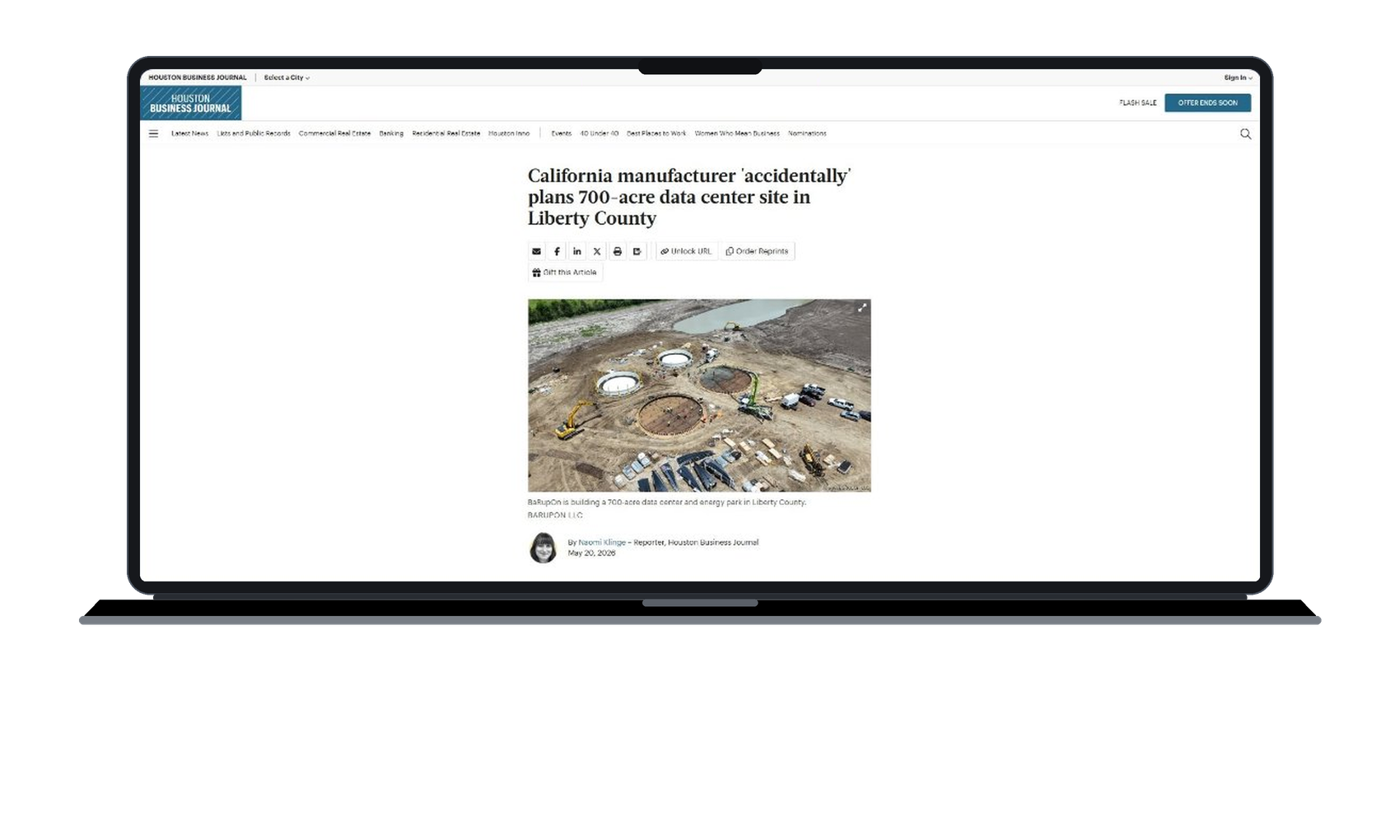
AS FEATURED IN THE HOUSTON BUSINESS JOURNAL — MAY 20, 2026
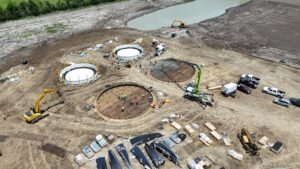
We’ve got some news we’re pretty excited about: the Houston Business Journal just wrote about BaRupOn. The story tells how a medical equipment company ended up building a 700-acre data center and energy park in Liberty County — honestly, not where we expected to be a few years ago, but here we are.
Here’s the short version of how it happened, in case you missed the piece.
It started with test kits
We started out back in 2014 as a small shop. Then Covid hit, and overnight we were making test kits. We went from five or ten people to a few hundred in a matter of months. It was a wild stretch, and it changed everything about where the company was headed, our COO Balaji Tammabattula told the Journal.
All that work led to a government contract to make methacrylic acid — a chemical that goes into a lot of the medical equipment we were already building. It was new territory for us, but it felt like a natural next step.
“When we got the contract, we figured the middle of the country was the place to actually make this stuff,” Balaji said. “We looked at Houston, other parts of Texas, Louisiana. Liberty County had everything we needed — and then some.”
We found the site on the corner of Highway 90 and Woodson School Road. We like to joke that we’re accidental data center builders. Sometimes you just see an opening and decide to go for it.
More land than we bargained for
We had a checklist of six things we wanted in a site: plenty of land, close to ports, a city, and rail, good water access, and rules we could work with. Liberty County ticked every box.
Funny thing is, we only needed about 60 acres. But the family trust that owned
the land wanted to sell all 700 of them. So we sai
d, fine — we’ll take the whole thing and figure out the
rest as we go. That decision is a big part of why we’re where
we are now.
Then came the power
Back in early 2024, we figured we’d need about 30 megawatts to run the plant once it went live in 2026. We thought hooking up to the grid would be the easy part. It wasn’t — so we got creative.
We reached out to Kinder Morgan (NYSE: KMI), which runs a hub about a mile down the road, to talk about buying natural gas. One thing led to another, and we
ended up contracting for around 27,000 MMBtu — enough for
roughly 300 megawatts, way more than the 30 we needed for the chemical plant. The gas ru
ns us somewhere around $400 to $500 million a year, but it puts us in a real position on the energy side.
So who uses all that?
With 640 acres and a big chunk of extra power sitting there, we started talking to hyperscalers about bringing in data center tenants.
We’re also planning to put rooftop solar across the 4.5 to 5 million square feet of buildings we’re putting up — that adds about 240 MW. Between the gas and the solar, the site will have over 400 MW to work with, which is a solid start for hyperscalers in their early phases.
We’re not stopping there. We’re looking at small modular nuclear reactors to add even more down the line. We’ve already done a feasibility study with Nano Nuclear Energy and brought on some scientists from the Department of Energy to help.
“Nuclear’s a longer game,” Balaji said. “Realistically we’re talking 2030, 2031, 2032. But we’re getting a head start now.”
Up and running this year
The chemical plant is on track to come online before the end of the year — we’ve got until Dec. 15 under the contract, and we plan to make it.
A lot of the structures were built off-site and are getting assembled on-site now, which moves things along a lot faster than building from scratch. All told, we and the government are putting $100 million into the chemical facility, and we’re spending about twice what the government is on our end.
We’re expecting around 300 people at the manufacturing site, and we’re hiring right now.
“We need the engineers involved early, before the real work starts,” Balaji said. “And we’re building a power plant on top of all this, which is its own thing — so we’ll be bringing on a lot of people for that too.”
We’re still in conversations with potential data center tenants, and we expect one to sign on late this year or early in 2027.
And if it takes a little longer? We’re not worried. Someone asked Balaji what happens if no hyperscaler shows up. “That’s fine,” he said. “There are plenty of good ways to put this power to use.”
You can read the full story in the Houston Business Journal.