
As U.S. policymakers renew focus on domestic energy resilience and strategic supply chain capacity, one company is building the infrastructure that will redefine how America powers its innovation economy.
While major utilities like NextEra Energy, NRG and Southern Company expand traditional renewable and natural gas portfolios, BaRupOn, a purpose-driven infrastructure and energy firm, is taking a different and more vertically integrated path.
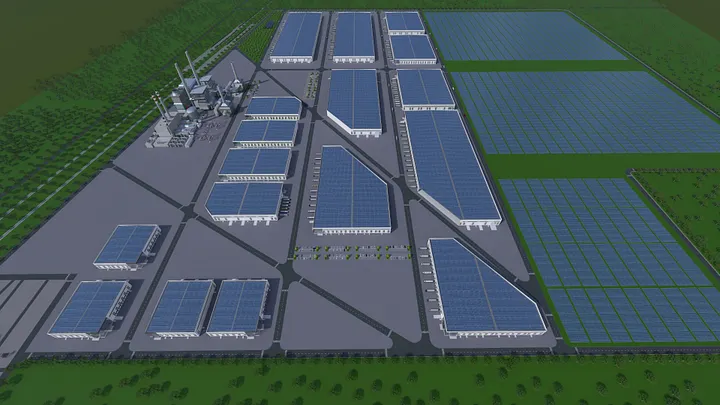
Its Liberty American Multi Power Source Innovation campus — known as LAMP — is a 701-acre development in Liberty, Texas. LAMP is engineered as a unified ecosystem where power generation, high-performance computing and advanced industrial innovation are co-located by design.
A New Kind of Energy Company
BaRupOn has operated largely under the radar since its founding in 2014, expanding quietly from healthcare manufacturing and federal contracting into power generation, energy storage, and infrastructure. Where most energy companies focus narrowly on solar, gas or nuclear generation, BaRupOn’s strategy is integration.
The California-based company recently announced their project, LAMP which is planned for 3 gigawatts of hybrid power capacity and 4.5 million square feet of innovation and data center space. Rather than generating power and seeking customers afterward, BaRupOn is aligning generation with persistent on-site demand. Energy is treated not as a commodity, but as the strategic foundation of America’s next technological and industrial cycle.

The core of the campus is a multi-source power architecture anchored in natural gas baseload generation, complemented by planned small modular nuclear reactors to deliver long-duration, carbon-free power.
High-density distribution networks are being engineered to support artificial intelligence computing clusters, robotics research environments and advanced data center operations. This model is designed to ensure stability, reliability and continuity of power at a scale that conventional grid infrastructure increasingly struggles to deliver, particularly as AI and computation workloads accelerate nationwide.
Why Texas Makes Sense
Texas provides the structural advantages that make this model possible. The The Electric Reliability Council of Texas (ERCOT) grid allows for faster deployment and flexible integration. The region sits atop one of the strongest natural gas supply chains in the world, supported by pipeline density, industrial talent and global energy expertise.
Located about forty minutes from Houston, the LAMP campus is positioned within reach of Gulf Coast logistics networks, engineering workforces, research universities and the industrial ecosystems that support large-scale innovation.
Powering the Age of Intelligence
The age of intelligence requires energy environments built for continuous computation — stable, local and controllable. Traditional data centers are increasingly exposed to transmission congestion, volatile demand charges and grid instability. LAMP solves for these risks by co-locating generation and consumption, reducing exposure to external grid constraints and ensuring predictable long-term energy economics. In this framework, power is not an overhead cost, it is rather the enabling infrastructure of innovation.
LAMP is being built as a hub for hyperscale and sovereign AI computing, robotics and autonomous systems engineering, advanced materials development, defense innovation programs and next-generation industrial R&D. It represents a model for how the United States restores innovation sovereignty — by concentrating power, computation, research and manufacturing capacity within secure, domestically controlled environments.
America’s most strategic industries now require local power, local infrastructure and operational independence. BaRupOn has positioned LAMP as the national template for these future innovation ecosystems as a campus where energy and intelligence are designed to advance together.